Thursday, February 24, 2011

Cervix Just Before Menstruation

Osservati dischi di formazione planetaria in due stelle

I pianeti si formano in dischi di gas e polveri che circondano le giovani stelle. Gli astronomi sono stati in grado di ottenere, per la prima volta, immagini dettagliate di tali dischi protoplanetari attorno a due stelle, grazie al telescopio Subaru delle Hawaii. Le immagini rivelano con chiarezza caratteristiche come gli anelli e le lacune presenti che sono associate con la formazione di pianeti giganti.


Le osservazioni fanno parte di una indagine sistematica per la ricerca di pianeti attorno a stelle con dischi di formazione planetaria, condotta grazie ad una telecamera ad elevato contrasto progettata specificamente per questo scopo.
I sistemi planetari come il nostro formed by the force of gravity which collects the gas and dust made by the advanced star formation in a dense, flattened disk of material orbiting the star. The same force of gravity of the denser material around nuclei to form heavier compression of dense bodies, called planets. Recent years have seen substantial progress in both observations (mostly indirect) and in the development of theoretical models on the disks "protoplanetary". The two intriguing new observations have added new details to reveal some structures that had never been seen directly.

The first of the two stars is observed LkCa 15, which is located about 450 light years from Earth in the constellation Taurus. With a few million years of age, LkCa 15 is a young star from the Sun is a thousand times older. From previous observations of its infrared spectrum and analysis of its emissions, scientists have inferred the presence of a large gap in the center of its protoplanetary disk. The new images show the starlight shining off the disk surface, which outline clearly for the first time the cutting edge. Even more interesting is the elliptical shape of the gap that is not centered on the star, but it is lopsided.

"The most likely explanation for the gap LkCa disk 15 and in particular its asymmetry, is that one or more planets, newborn from the material of the disc, have swept away the gas and dust along their orbits, "says Christian Thalmann, who led the study at the Max Planck Institute for Astronomy (MPIA). Interestingly, the gap in the disk is large enough to accommodate all the orbits of the planets in our Solar System. LkCa It is assumed therefore that 15 might be about to form a whole planetary system similar to ours. "We have not yet found the same kinds of planets," said Thalmann, "but this may change soon."
The second observation stellar, led by Jun Hashimoto (National Observatory of Japan), focused on AB Aur in constellation, at a distance of 470 light years from Earth. This star is even younger, with an age of only one million years. Even the earliest observations showed length scales comparable to the size of our solar system, with a ring of material inclined with respect to the equatorial plane of the disk, curiously, is not distributed symmetrically around the star, with irregular features that indicate the presence of at least one planet very solid.
The observations made with the instrument HiCIAO installed on the 8.2-meter Subaru Telescope corrects distortion of Earth's atmosphere and physically block most of the light from the star, allowing you to see which ones that exist around it.
The observations are part of SEEDS project, an acronym for Strategic Explorations of Exoplanets and Disks with Subaru.

Photo above: L 'image above, taken with the camera installed on HiCIAO Subaru Telescope shows a bright arc of diffuse light (white) from the protoplanetary disk around the young star LkCa 15 ( the center, masked with a dark circle). E ' an arc cutting the edge of the internal shape with a large gap in the disk. The gap is very unbalanced and is much wider on the left side, and was probably dug by one or more planets orbiting the star babies. (Credit: Copyright MPIA (Christian Thalmann) & NAOJ) .

Translation by Arthur McPaul

Source: http://www.sciencedaily.com/releases/2011/02/110218083610.htm

Tuesday, February 22, 2011

Black Bumps On Scrotum

L'acqua lunare contiene sodio

Ice recently discovered water on the bottom of a crater near the moon's south pole is accompanied by metallic elements such as mercury, magnesium, calcium and trace amounts of silver. Now you can add to the mix also sodium, according to Dr. Rosemary Killen of the NASA Goddard Space Flight Center.

The recent discovery of significant deposits of water on the moon were nothing short of amazing geological view of its troubled history. Heavy bombardment by asteroids in the first phase of his life and because of its weak gravity and the strong solar radiation, has been deprived of almost all of its atmosphere.

This made the lunar surface dry and arid.
However, due to the orientation of the Moon from the Sun, scientists have theorized that the cluster would deep craters in permanent shadow, and then very cold, so as to retain volatile substances like water from cometary impacts or chemical reactions with hydrogen, one of the main components of the solar wind.

On 9 October 2009, NASA's Lunar Crater Observation of the impact and Sensing Satellite (LCROSS) in the region permanently shadowed crater Cabeus confirmed that a surprisingly high number of water ice is present together with small amounts of many other elements, including metal.

LCROSS was launched June 18, 2009 as a mission partner of the NASA Lunar Reconnaissance Orbiter, or LRO, the NASA Kennedy Space Center in Florida. After separating from LRO, LCROSS probe has entered a series of orbits around the Earth.
After driving for about 113 days nearly 5.6 million miles (9,000,000 kilometers), LCROSS and the Centaur rocket split over the impact on the moon and reach the ground and explode, LCROSS and LRO spacecraft observed with their instruments board. Were collected about four minutes of data from the first impact with the LCROSS lunar surface.
Killen and his team looked at the impact of the LCROSS Solar Telescope McMath-Pierce at the National Solar Observatory in Tucson, Arizona. They are
were the only team able to see the results of the impact from the ground.

impacts have vaporized material from the crater floor Cabeus, including water and sodium. After the steam plume rose to about 800 meters (about 2,600 meters) high enough to remove the shadow from the edge of the crater, the sun's light has stimulated the sodium atoms, causing them to issue a yellow-orange glow. A high resolution spectrometer, Echelle, attached to the telescope has detected this unique glow. The instrument separates light into its colors and pressed to identify those materials issued by the colors when excited by radiation or by other events in space.

The spectrometer observed the sky through a narrow slit to separate the colors, but the team then had to assume the shape and temperature of the plume and estimated the total amount of sodium released from the impact. Using a computer model and data from other instruments on LRO and LCROSS, the team calculated that have been issued by one to two kilograms (about 2.2 to 4.4 pounds) of sodium.
"This is the 1-2 per cent of the amount of water released from the impacts," said Killen. "Our oceans have a comparable amount of sodium to water ratio, about one per cent" (The amount of ash depends on the temperature derived from observations taken steam).
The presence of these large amounts of sodium raises the question whether it can be reached on the lunar surface by cometary impacts and then trapped in permanently shadowed regions, where it was then frozen.

The solar wind carries small amounts of sodium, which could have become an integral part of the lunar surface and may have been released from lunar rocks, which own about 0.4 percent sodium. Sodium may also have been released from lunar rocks by impacts of meteoroids. (LCROSS impacts do not have enough energy to vaporize the rock, so it is unlikely that the plume of sodium vapor is just came from rocks at the impact site, according to Killen).

"The two percent sodium water is consistent with the amount of sodium in comets, so maybe most of the sodium and water from cometary impacts," said Killen. Although only a 'hypothesis, it is possible that comes from a different source or even from a variety of sources, including lunar volatiles trapped in the cold by chemical processes with the interaction of the solar wind with the surface. "The best evidence for a cometary origin could only be an analysis of isotopes of hydrogen lunar water, concludes Killen.

Isotopes are versions of an element with different weights, o masse. Ad esempio, un atomo di deuterio è una versione più pesante di un atomo di idrogeno comune, perché ha una particella extra,  un neutrone, nel suo nucleo centrale. Il deuterio può essere sostituito con l'idrogeno in una molecola d'acqua, ma è molto meno comune e la sua concentrazione varia  nel Sistema Solare. Se il deuterio è nello stesso rapporto con l'idrogeno presente nel ghiaccio delle comete, è possibile l'acqua provenga da impatti cometari.
Dal momento che le comete sono come "palle di neve sporca", vorrebbe dire che gran parte del sodio e di altri composti volatili provengono proprio dalle comete.

Il team prevede di far luce sull'origine delle acque lunar and other volatile compounds using the data of the next mission Lunar Atmosphere and Dust Environment Explorer (LADE), which should be launched in May 2013.

The mission will enter into lunar orbit to observe its tenuous atmosphere (exosphere technically called because it is so thin that atoms rarely collide with each other above the surface).

The research was funded by the NASA Dynamic Response Environment (dream) of the Moon project.

The McMath-Pierce telescope is operated by the National Solar Observatory, which is funded by the National Science Foundation and operated by the Association of Universities for Research in Astronomy. The scientific report on this research was published in Geophysical Research Letters in December 2010.


Photo: chamber shows the LCROSS plume emitted about 20 seconds after the impact of the Centaur rocket (Credit: NASA)

Video: Video telling the LCROSS mission with the photographs of the NASA


Monday, February 21, 2011

2009 Honda Ridgeline Rear View Camera

Dalla NASA, ancora ipotesi su Tyche, il pianeta X

In November 2010, the scientific journal Icarus has published a document of astrophysicists JJ Matese and Daniel Whitmire, in which they proposed the existence a binary companion to our Sun, the largest of Jupiter, near the "Oort Cloud", a distant storage of small icy bodies at the edge of our Solar System.

The researchers called this hypothetical body "Tyche". According to their theory, the evidence of the discovery, through analysis of data Giuga which issued the Wide-field Infrared Survey Explorer (WISE) of NASA.
WISE is a NASA infrared telescope, launched in December 2009, which scanned the entire sky in four infrared wavelengths, about 1.5 times. In its investigation has already captured more than 2.7 million images of objects in space, ranging from asteroids and comets to distant galaxies relatively close to Earth.
Recently, WISE has completed a second mission extension extra scansionanado the asteroid belt, the Universe in two far infrared bands. Among the findings already confirmed at the time included a brown dwarf, 20 comets, close to 134 items Earth (NEO), and more than 33,000 main belt asteroids between Mars and Jupiter.
Following the conclusion of its investigation, WISE has been hibernating in orbit in February 2011. But the analysis of data by scientists Tegli continues. The first publication of such data is scheduled for April of 2011, but the final version of the full survey will be released until March 2012.
these days is back in the news for the possibility that soon to be confirmed the presence of "Planet X", which is why this site is built, unique in the world. Makes great sense that NASA is talking about the same now open. Until a few years ago, the famous "Planet X" was little more than mere fiction and meant to speak heresy. In Italy, there are still many scientists obtuse or amateurs with blinders on, who believe that talking about Planet X is a waste of time, but probably soon will permanently change their minds and in any case, if NASA is talking about it, is never lost of time.

The same NASA gave an interview to remove doubts, uncertainties and curiosity about Tyche.

Q: When could confirm the presence of the planet Tyche, the data in analisi di WISE?
A: E' troppo presto per sapere se i dati WISE confermano o escludono un grande oggetto nella nube di Oort. Le analisi nei prossimi due anni saranno indispensabili per determinare se WISE ha effettivamente rilevato tale mondo. Le prime 14 settimane di raccolta dei dati, saranno rilasciate nel mese di aprile del 2011, ma non saranno probabilmente sufficienti. L'indagine completa, prevista nel marzo 2012, dovrebbe fornire una maggiore comprensione. Una volta che i dati WISE saranno completamente trasformati, rilasciati e analizzati, le ipotesi sull'esistenza di Tyche di Matese e Whitmire saranno effettivamente testate.
D: E' certo che WISE avrebbe osservato un pianeta?
A: E' probabile ma non scontato che WISE possa confermare o meno l'esistenza di Tyche. Dall'analisi delle immagini ottenute 1,5 volte del cielo da WISE a distanza di 6 mesi, gli scienziati dovrebbero vedere un cambiamento della posizione apparente di un corpo grande nella nube di Oort. Le due bande utilizzate nella copertura del cielo secondo sono state progettate per identificare le nane brune o grandi pianeti gassosi come Tyche.
 
D: Se Tyche fosse davvero scoperto, perché ci sarebbe voluto così tanto tempo per trovare un altro pianeta del nostro Sistema Solare?
A: Tyche sarebbe troppo freddo e debole per essere osservato da un telescopio a luce visible. The infrared telescope could resume the faint glow of such an object, looking in the right direction. WISE is an infrared telescope that looked in all directions.
Q: Why is this item called "Tyche" (a greek name), when the names of the other planets are derived from Roman mythology?
A: In the 80s we assume the presence of "Nemesis" (name derived from the Greek goddess of discord) a hypothetical red dwarf star (Muller) or brown dwarf, proposed to explain periodic mass extinctions that occurred in the past on Earth. Nemesis would follow a highly elliptical orbit, able to disturb and deflect towards the inner solar system comets in the Oort cloud, about every 26 million years.
Some of these comets would have caused catastrophic consequences for life on Earth. Recent scientific analysis no longer support the idea that the extinctions on Earth occur at regular intervals and repeat. Thus, the Nemesis hypothesis is no longer followed. However, it is still possible that the Sun has a companion in a far more circular orbit with a period of a few million years. To distinguish the object from the malevolent "Nemesis", astronomers Matese and Whitmire, chose the name of the benevolent sister Nemesis in Greek mythology, "Tyche".

from rumors and the great interest that this topic is stirring in the press, it is conceivable that there really Tyche and NASA should release the data of the discovery in 2012.
Some interesting conjectures are conceivable in this regard.

Tyche may have up to a hundred moons, some big enough to be bodies like Pluto, Eris, Makemake and Sedna.
This body may be partly responsible for the "shower" of asteroids and comets that come on Jupiter and sometimes on Earth, causing mass extinctions.
In the photo below look at the first and only brown dwarf so far discovered through data WISE:


The brown dwarf, (emerald green object that you see above) marked by the circle, she was named WISEPC J045853.90 +643451.9 and could be very similar to an object on the edge of the Solar System as the same Tyche.
The brown dwarf WISEPC J045853.90 +643451.9 is currently the only confirmed by preliminary data from WISE and being away solto between 18-30 light-years from Earth, is in fact at the time, the brown dwarf the closest ever found.


Source

Saturday, February 19, 2011

100 Watt Stereo Receiver

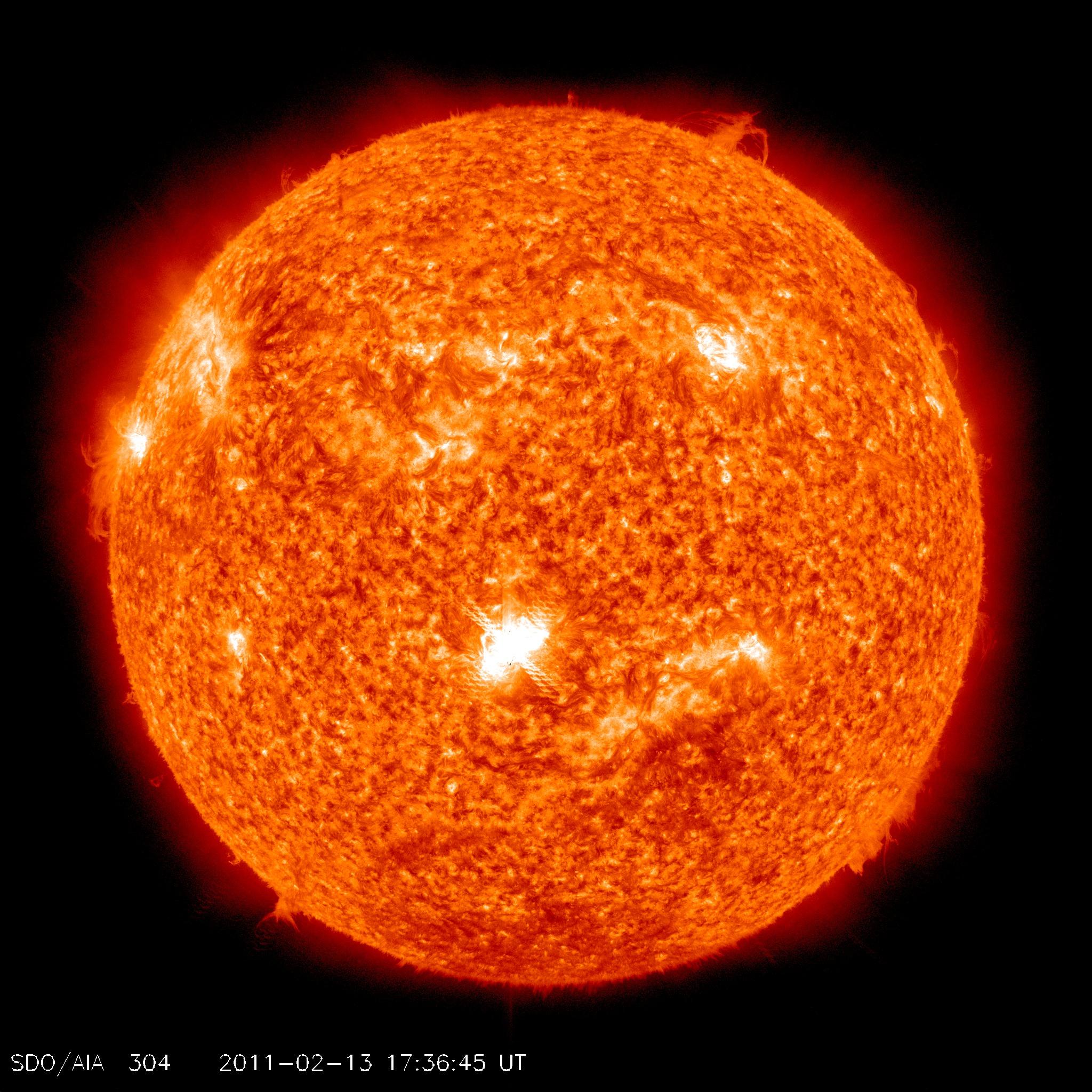
Il Sole si sveglia: esplosione di classe X. Colpita la Terra.


"A powerful solar flare of class X, February 15 has thrown billions of tons of charged particles toward Earth, in what are called coronal mass ejections (CMEs), resulting in a storm geomagnetic activity in the Earth's magnetic field " said Baker, director of CU-Boulder's Laboratory for Atmospheric and Space Physics.

In astrophysics, a "solar flare " or even solar flare is a violent eruption of matter that explodes from the photosphere of the Sun, with an energy equivalent to tens of millions of bombs atomic. These potenti espulsioni possono causare problemi di sicurezza che vanno dalla rottura dei sistemi di navigazione aerea e o alle reti elettriche o posson mettere a rischio la sicurezza degli equipaggi delle compagnie aeree e gli astronauti nello spazio.
I brillamenti sono spesso associati alle macchie solari e sono probabilmente causati dal rilascio di energia in occasione del fenomeno di riconnessione delle linee di campo magnetico.  
Le onde d'urto risultanti viaggiano lateralmente attraverso la fotosfera e verso l'alto attraverso la cromosfera e la corona, a velocità dell'ordine di 5.000.000 di chilometri all'ora (ovvero 1.389 km/s, contro i 300.000 chilometri al secondo della speed of light).

Flares are classified as:
A
B
C
M
X
according to their brightness in X-rays near the Earth, measured in watts per square meter.

Each class is ten times more powerful than before, with X (the largest) of 12 to 10 W / m², and also is divided linearly from 1 to 9, then a blast X2 is four times more powerful than an M5.
Solar activity is normally between classes A and C.
I have a few flares C effects on the Earth, while the more powerful M and X can cause damage.
sometimes exceed the maximum value (X9): August 16, 1999 and April 2, 2001 were measured of the X20 flare, but they were outweighed by the 4 November 2003 was estimated at X45 and is the most powerful ever recorded. The region of sunspot 486 was the most turbulent ever seen.


"The sun is coming back to life" , said Baker, in his report entitled " Severe Space Weather Events. Understanding of society and economic impacts " . The Sun was going through a long period of quiet, the largest since the beginning of the twentieth century. From the scientific point of view, a flare of class X, is the most powerful type of solar flare. For Baker in this regard: "... we can not afford to be complacent when operating in near-Earth space environment."
According to the National Oceanic and Atmospheric Administration, a number of expulsions coronal mass can reach the Earth's atmosphere over the next few days.
"The man's dependence on technology makes the company more sensitive to the effects of space weather," said Baker. "But scientists and engineers have made great strides in recent decades with regard to this phenomenon . We know much more about what is happening and we can build more robust systems to withstand, "said Baker. " It will be interesting to see how our technology systems will be able to withstand the rigors of space weather, while the Sun back to higher levels of activity. "

Eruzioni così violente possono rilasciare nello spazio miliardi di particelle alla volta. Nelle prossime ore questo sciame che sta viaggiando verso di noi investirà la Terra. Con quali conseguenze? C’è da temere per la salute? Rischiamo black-out? Facciamo il punto con Alessandro Bemporad, fisico solare dell’INAF-Osservatorio Astronomico di Torino .

Bemporad, che succede sulla nostra stella?
Questo brillamento è il primo di una serie di eruzioni a cui assisteremo prossimamente. Segna il risveglio del Sole, l’entrata cioè in una nuova fase di attività, dopo il periodo di minimo. Il picco di attività è previsto tra il 2012 e il 2013. Un’eruzione solare si genera a causa dell’emissione di intensi campi magnetici sulla fotosfera, la superficie esterna del Sole, visibili come macchie solari. Questo determina improvvisi rilasci di energia e l’espulsione di particelle di plasma altamente ionizzato ad alta velocità nello spazio interplanetario. La tempesta solare è costituita da tre componenti: radiazione ultravioletta e raggi X, che raggiunge la Terra in 8 minuti; una seconda componente di particelle relativistiche, che arrivano in qualche ora; infine, una bolla di plasma di enormi dimensioni che può investire la Terra nei giorni successivi al brillamento.

Quali sono le conseguenze di una tempesta Solar?
The high-energy particles, injected along the earth's magnetic field lines, can damage satellites, cause it to drop, disrupt communication systems and satellite radio broadcasts. These days you can complain about malfunctions of phones and GPS navigators.

risk of a blackout?
can happen. The current geomagnetic, if channeled in the power lines, transformers can blow up power plants. In the eighties has happened in Quebec.

Is there any danger to the astronauts on the International Space Station? For the astronauts
worst is already past, the greatest danger is the bombardment of X-rays and high energy particles. It is estimated that the most intense solar flare occurred between Apollo 16 and Apollo 17 would kill an astronaut if he had been caught during extravehicular activity outside the spacecraft.

Who's down to earth has nothing to fear for their health?
No, thank goodness we are protected by the magnetosphere. The only problem may be with passengers, particularly those on board, on air routes near the poles where the magnetic field lines convey the high-energy particles from the Sun

eruptions of the Sun also determine one of the most spectacular phenomena of nature: the aurora borealis. How do they occur?
The phenomenon depends on the excitement of the atoms in the upper atmosphere which are affected by high energy electrons from the Sun so the sky is tinged with colored lights, a great visual effect.

is a good time to book a holiday at the poles?
Yes, the frequency of solar eruptions and their intensity will increase, and consequently the aurora borealis. This recent solar storm was the most intense of the last four years, but there are other more. We will see the beautiful. As on the other hand occurs cyclically every 11 years.

riusulterebbe from numerous sources that are to be affected by the flare X class was the Asian region of China. Some damage to navigation systems but nothing to worry about.


By Arthur McPaul


Sources:
http://it.wikipedia.org/wiki/Brillamento # Classification
http://www.media.inaf.it/2011/02/17/le-conseguenze-delleruzione- Solar /
http://www.centroufologicoionico.com/articoli/news/436-la-cina-nel-mirino-dellultima-eruzione-solare